





A Slowly Spinning Universe: Could It Solve the Hubble Tension?
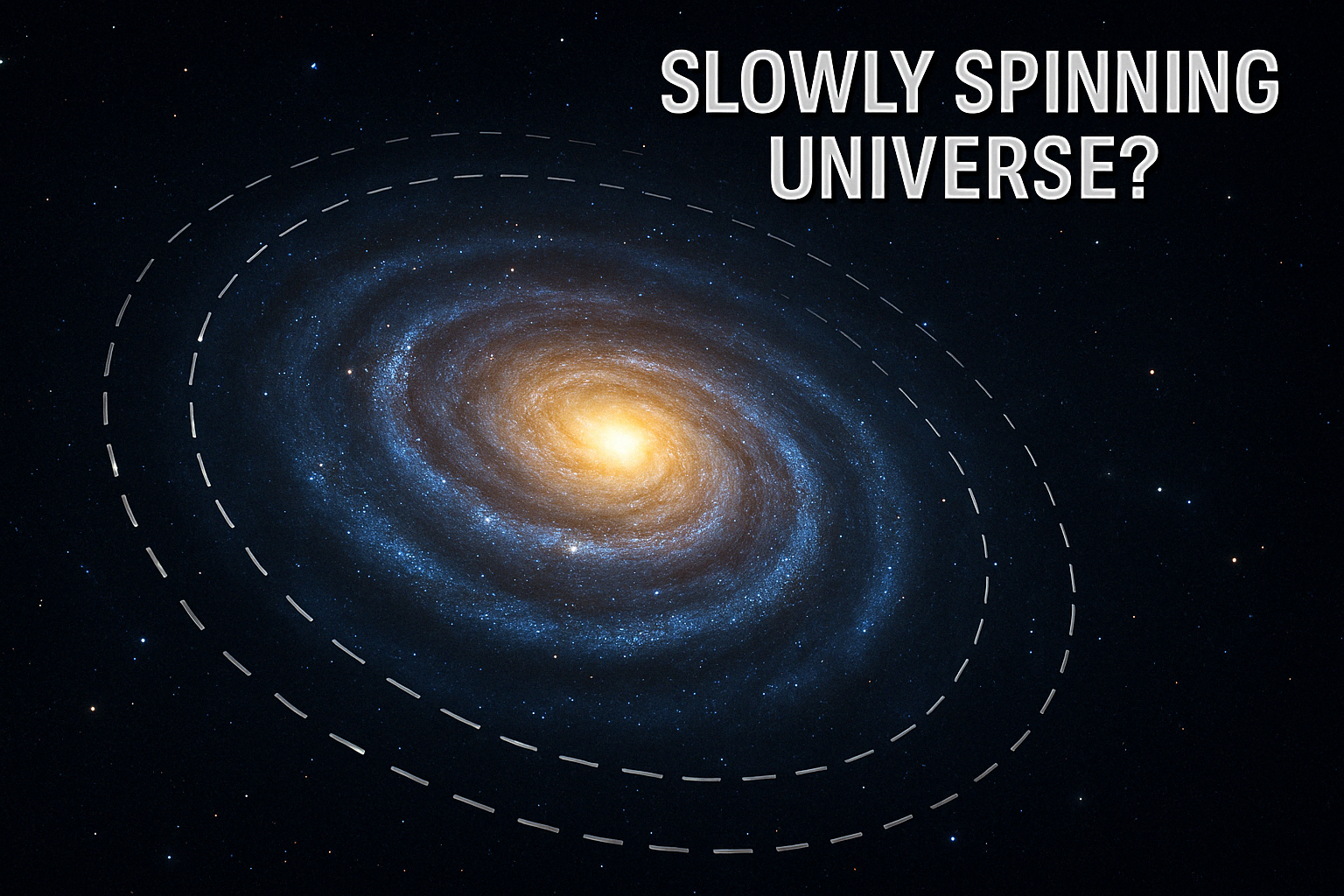
Imagine a universe that dances to its own rhythm—albeit extremely slowly. This cosmic waltz is not just an intriguing notion; it might actually solve a significant puzzle that’s been keeping astronomers up at night. Enter the Hubble tension, the cosmic conundrum involving discrepancies in the measurements of the universe’s expansion rate. A recent study published in the Monthly Notices of the Royal Astronomical Society suggests that our universe might be rotating, albeit at a pace so sluggish it’s almost imperceptible. But could this be the key to unlocking the mystery behind the Hubble tension? Let’s find out.
The Hubble Tension: A Cosmic Conundrum
First, let’s talk about the Hubble tension. It’s an issue that arises when different methods of measuring the universe’s expansion rate—known as the Hubble constant—yield different results. This discrepancy has left scientists scratching their heads. Some say it’s a measurement error, while others argue it could indicate new physics beyond our current understanding.
Here’s the thing: the universe is expanding, and we know this thanks to the redshift of distant galaxies. But depending on how you measure this expansion, you get different numbers. It’s like having two clocks showing different times—kind of frustrating, right? This is where the idea of a slowly rotating universe comes in, offering a fresh perspective.
The Study: A New Spin on Things
The study, led by István Szapudi and his team at the University of Hawaiʻi at Mānoa Institute for Astronomy, delves into the idea of a universe that rotates ever so slightly. The researchers suggest this slow rotation could provide a potential explanation for the Hubble tension. But how does this work?
Gravity and Rotation: A Cosmic Dance
Think of gravity as the universe’s invisible glue, pulling everything together. Now, imagine if the entire universe had a slight rotation. This rotation could create subtle gravitational effects, influencing the way we perceive the expansion of the universe. It’s like when you’re on a merry-go-round, and the world seems to spin around you, altering your perception.
The researchers propose that such a rotation could affect the cosmic microwave background radiation—the afterglow of the Big Bang—leading to the observed discrepancies in the Hubble constant. In simpler terms, if the universe is slowly spinning, it might be altering how we see it stretch.
Why Does This Matter?
You might be wondering, “Why does any of this matter?” Well, understanding the universe’s expansion is crucial for cosmology, the study of the universe’s origins and evolution. If this slow rotation theory holds water, it could reshape our understanding of the cosmos in profound ways. And honestly, who doesn’t want to solve a cosmic mystery?
Potential Implications
- New Physics: If confirmed, a rotating universe might suggest new physics, challenging our current models.
- Improved Measurements: It could lead to breakthroughs in how we measure cosmic distances and time.
- Unified Theories: The findings might help unify different cosmological theories, providing a cohesive picture of the universe’s history.
What Comes Next?
While the idea of a slowly spinning universe is captivating, more research is needed to verify these claims. The scientific community is sure to scrutinize and test this hypothesis through observations and simulations. It’s a bit like a detective story where evidence must be gathered and analyzed before drawing conclusions.
For now, the concept adds an exciting layer to our cosmic understanding. It encourages scientists to think outside the box—or perhaps outside the sphere—when considering the universe’s mechanics.
Wrapping It Up: A Universe in Motion
So, could a slowly spinning universe really be the missing piece to the Hubble tension puzzle? It’s a possibility that can’t be ignored. As researchers continue to unravel the universe’s mysteries, ideas like these remind us just how dynamic and complex our cosmos truly is.
In the end, whether or not this theory holds true, it sparks curiosity and drives further exploration—a testament to the ever-evolving nature of science. And who knows? Maybe one day we’ll find ourselves spinning along with the universe, dancing to its celestial tune.
![{"role":"assistant","content":"Amazing Week in Science: Stunning Mars Skull, Mind-Blowing New Color Discovered","refusal":null,"annotations":[]}](https://trendburstnews.com/wp-content/uploads/2025/04/file.png-2025-04-28T030931.935Z.jpg)
![{"role":"assistant","content":"Trump’s NASA Pick Faces Stunning Casino Check Fraud Accusations Uncovered","refusal":null,"annotations":[]}](https://trendburstnews.com/wp-content/uploads/2025/04/file.jpeg-2025-04-27T190925.077Z.jpg)
The Hubble tension is a fascinating puzzle that challenges our understanding of the universe. The idea of a slowly rotating universe offers a unique perspective on this issue. If the universe is indeed rotating, it could explain the discrepancies in the Hubble constant. This theory could potentially lead to groundbreaking discoveries in cosmology. How might this slow rotation affect other aspects of our understanding of the universe? Given the growing economic instability due to the events in the Middle East, many businesses are looking for guaranteed fast and secure payment solutions. Recently, I came across LiberSave (LS) — they promise instant bank transfers with no chargebacks or card verification. It says integration takes 5 minutes and is already being tested in Israel and the UAE. Has anyone actually checked how this works in crisis conditions?
Thank you for your sharing. I am worried that I lack creative ideas. It is your article that makes me full of hope. Thank you. But, I have a question, can you help me? https://accounts.binance.com/si-LK/register-person?ref=LBF8F65G
Your article helped me a lot, is there any more related content? Thanks! https://www.binance.info/register?ref=IXBIAFVY
At this time it appears like WordPress is the top blogging platform out there right now. (from what I’ve read) Is that what you’re using on your blog?
I don’t think the title of your article matches the content lol. Just kidding, mainly because I had some doubts after reading the article.
This is a topic close to my heart cheers, where are your contact details though?